Hot Agentic Models Right Now and How to Use Them

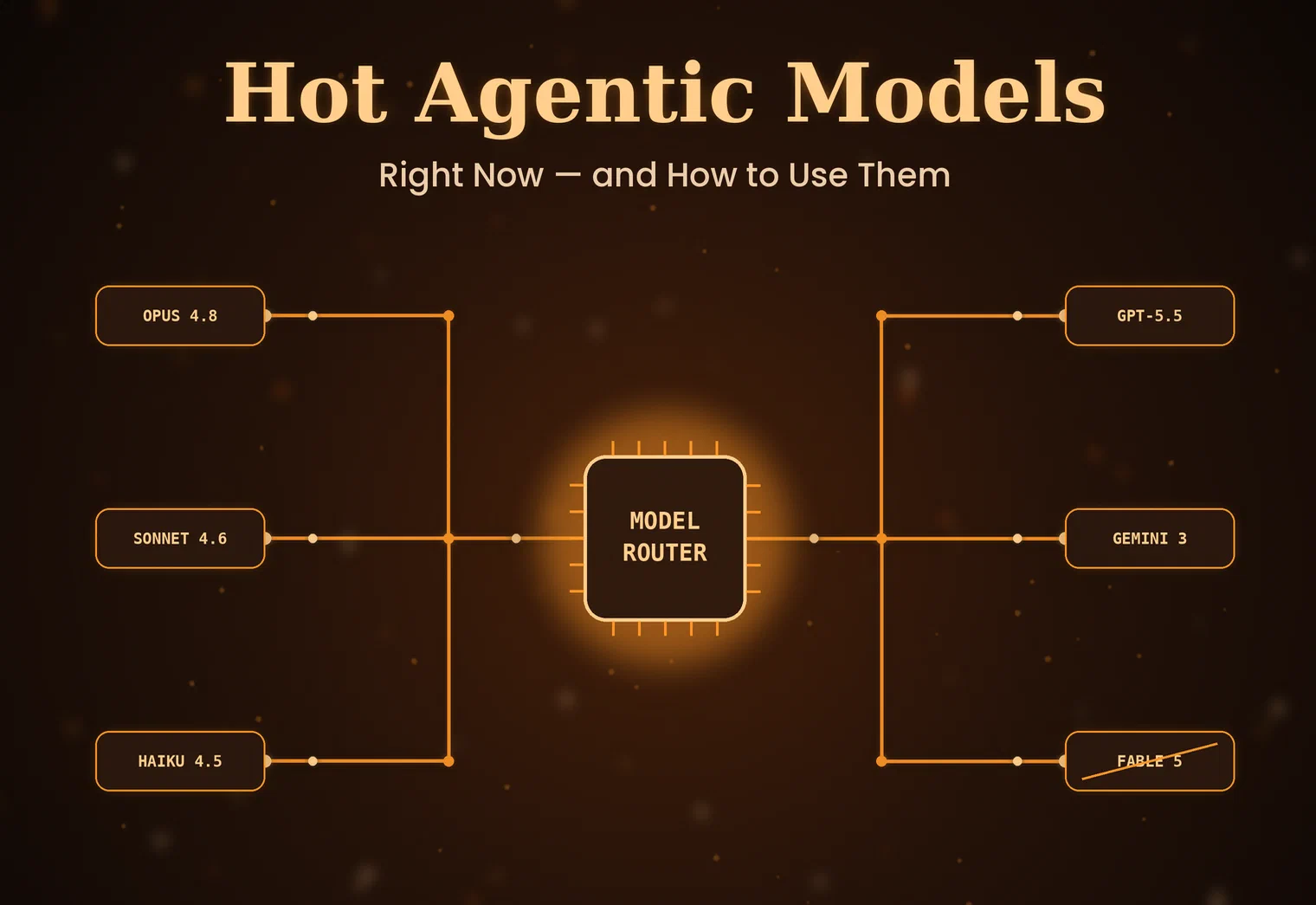
The model landscape moves fast enough that any list is half-stale by the time you read it, so let’s focus on what actually matters for a small dev shop: which models are genuinely good at agentic work right now, what they cost you per task, and how to wire them in without lighting money on fire. As of mid-2026 the frontier is a three-horse race, the gap between the leaders is smaller than the marketing suggests, and the smartest teams aren’t picking a winner at all. Here’s how to think about it.
The Models Actually Worth Your Attention
For sustained, multi-step coding work, three families lead. Claude Opus 4.8 is the current standout for complex software engineering, scoring around 88% on SWE-bench Verified and pairing naturally with agent workflows. OpenAI’s GPT-5.5 sits right alongside it, essentially tied on the same benchmark and especially reliable for structured output and tool calling. Google’s Gemini 3 Pro is the one to reach for when you’re throwing a genuinely large codebase at the model, because it uses its long context better than the others for code.
Two things to take from that. First, the leaders are close enough that for most everyday work you won’t feel a quality difference; you’ll feel the price and speed difference. Second, the headline frontier model is rarely the one you should run by default. The cheaper tier, models like Claude Haiku 4.5 and the various “flash” variants, handles a surprising amount of real work at a fraction of the cost. Reserve the expensive model for the tasks that actually need it.
Stop Picking One Model
The biggest shift in 2026 isn’t a new model; it’s that serious teams stopped choosing one. The pattern that wins is routing: send each task to the cheapest model that can do it well, and only escalate to the frontier when the task earns it. A practical setup looks like a fast, cheap model for triage and simple edits, a mid-tier model like Claude Sonnet 4.6 for standard feature work, and an Opus- or GPT-5.5-class model reserved for the hard refactors and gnarly debugging.
You don’t need to build a fancy routing layer to get most of this benefit. On a small team, you are the router. Develop a habit of asking “does this task need the expensive model?” before you fire it off. Renaming a concept across the codebase doesn’t. Untangling a race condition in your payment flow might. That one judgment call, made consistently, is the difference between a sane API bill and a shocking one, and it costs you nothing but attention.
The Tools That Wrap Them
Models are the engine; the tool is the car. For agentic work the three you’ll hear about are Claude Code, OpenAI’s Codex, and Cursor, and they’re not really competitors so much as different shapes. Cursor is an AI-first IDE you live in all day, best for daily editing with the model riding along. Claude Code is the most agentic of the three: point it at your repo and it reads the codebase, edits files, runs commands, and opens pull requests on its own. Codex leans into the background-task model, spinning up a sandbox, working a task in parallel, and surfacing a diff for you to review.
Most real teams in 2026 run two or three of these together on the same repo without conflict: an IDE for flow, an agent for the heavy lifting, a background runner for the stuff you’d rather not babysit. You don’t have to adopt all of it at once. Pick the one that matches how you already work and add the next only when you feel the specific pain it solves.
The Fable and Mythos Saga
If you want a single story that captures how fast and how strange this market has gotten, look at what just happened with Anthropic’s top tier. In April, Anthropic showed off Claude Mythos Preview, a model a clear step above the Opus line, posting eye-watering numbers like roughly 94% on SWE-bench Verified. It never went on general sale; access was held back to a small consortium because the same capabilities that make it a phenomenal coder also make it a phenomenal cyber weapon.
Then on June 9, Anthropic released Claude Fable 5, the first publicly available Mythos-class model, sitting a tier above Opus 4.8 at roughly double the price ($10/$50 per million tokens) and leading the agentic-coding evaluations. For exactly three days, the most capable coding model you could actually buy was sitting behind an API key. On June 12, the U.S. Commerce Department ordered Anthropic to suspend all access to both Fable 5 and the underlying Mythos 5 for every foreign national worldwide, citing national security after reports of a jailbreak that could unlock the model’s cybersecurity abilities. Anthropic complied, and as of this writing both remain offline with no restoration date.
What That Means for a Small Shop
Here’s why this matters even if you were never going to pay frontier prices. A best-in-class model appeared and vanished in seventy-two hours, for reasons that had nothing to do with the model getting worse and everything to do with forces entirely outside your control. If you had rebuilt your workflow around Fable 5 that week, you’d have spent the following Monday rebuilding it again. That’s the whole argument for routing in a single news cycle: build around roles, the cheap triage model, the standard workhorse, the frontier scalpel, and treat the specific model behind each role as a swappable part.
The reassuring part is that the everyday Claude line (Opus 4.8, Sonnet 4.6, Haiku 4.5), plus GPT-5.5 and Gemini 3 Pro, are all unaffected by any of this drama and more than enough for real client work. The model you pick matters far less than the discipline around it. The cost difference between using these tools carelessly and using them deliberately is enormous, and it lands entirely on small teams where every API dollar and every hour is felt. So default to the cheaper model, escalate on purpose, review everything an agent produces, and treat the frontier tier as a scalpel, not a hammer. The leaderboard will look different in six months, and that’s fine, because the habits don’t change even when the names do. If you’re trying to figure out which models and tools actually fit your stack and your budget, rather than chasing whatever topped the benchmark this week, that’s exactly the kind of thing we help small businesses sort out at FMLY Consulting.