AI Agents vs Automation: Knowing the Difference
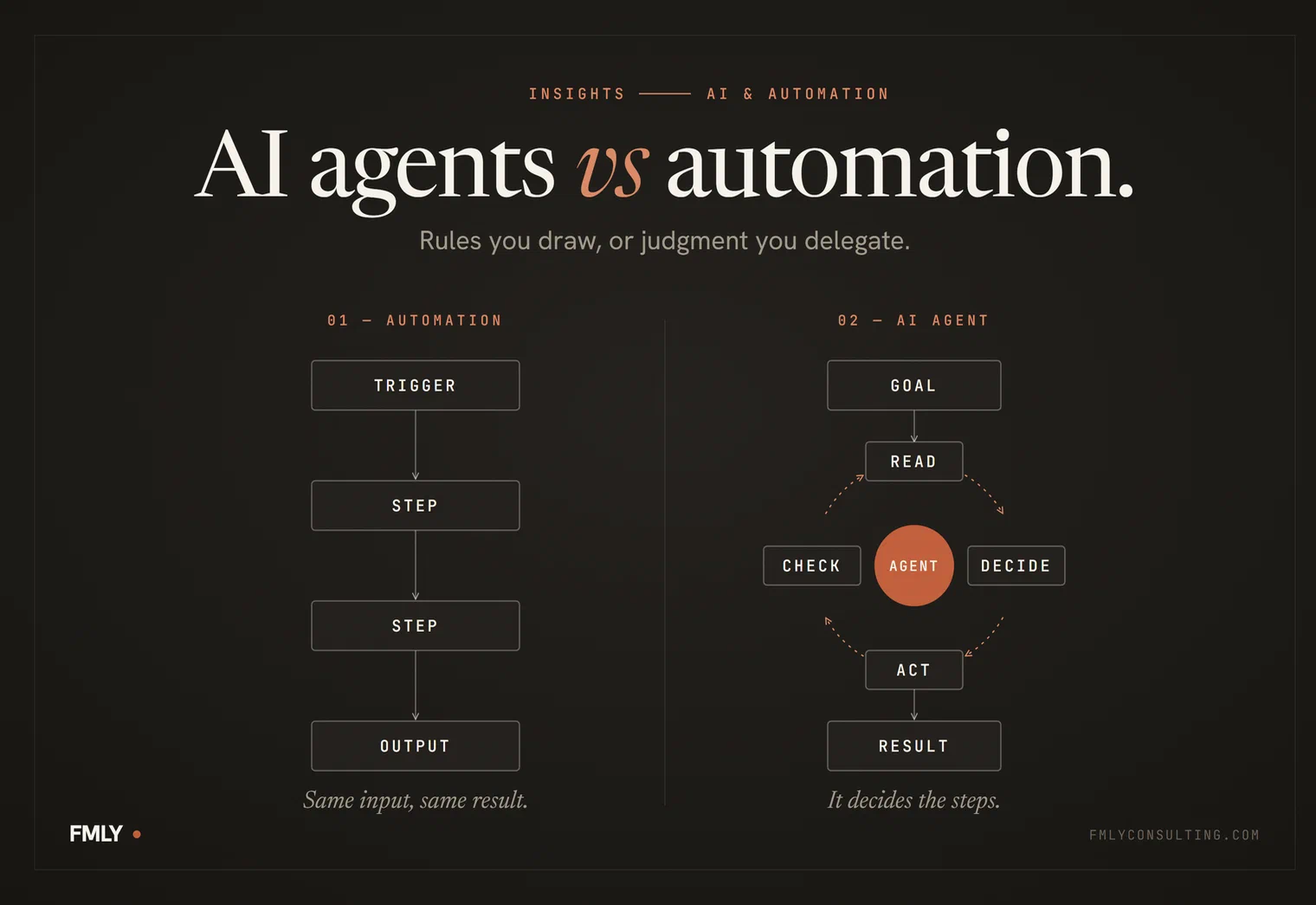
Somewhere in the last year, “can we get an agent for this?” became the new “can we put this in the cloud?” Clients ask for agents to send a welcome email when a form gets submitted. Vendors call a three-step Zapier flow with one AI call in the middle an “autonomous agent platform.” The words have blurred together, and that blur is expensive, because agents and automation cost different amounts, fail in different ways, and need very different levels of supervision. Picking the wrong one either means paying agent prices for a job a flowchart could do, or handing a flowchart a job that needs judgment and watching it break on the first messy input.
The Short Version: Rules vs Judgment
Automation follows a path you drew. Something happens, a fixed set of steps runs, and you get an output. An invoice gets paid, the CRM record updates, a thank-you email goes out. Same input, same result, every time. If something unexpected shows up, the automation either ignores it or throws an error.
An agent gets a goal and a set of tools, and decides the steps itself. It reads the situation, picks an action, checks the result, and loops until it thinks the goal is met. “Go through this shared inbox, sort the new leads from the support requests and the spam, draft replies for the leads, and flag anything that looks off” is agent territory. The inputs are messy, the number of steps changes every time, and the right action depends on reading what’s actually in front of it.
That flexibility is the whole point of an agent, and it’s also the cost. You trade predictability for adaptability. Sometimes that’s a great trade. More often than the marketing suggests, it isn’t.
When Plain Automation Wins
If you can draw the process as a flowchart without any boxes that say “it depends,” automate it. Don’t build an agent. Plain automation is cheaper to run, faster to build, easy to audit, and it doesn’t make things up. When it breaks, it breaks loudly, with an error message and a failed run you can see. An agent that goes wrong tends to fail quietly, with a confident, plausible answer that happens to be wrong. That’s a much worse failure to catch.
Most of the “AI projects” I get brought into turn out to be about ninety percent ordinary automation with one genuinely useful AI step in the middle. Classify this incoming email. Pull the key fields out of this PDF. Summarize these call notes into three bullets for the CRM. The workflow around that step stays fixed: trigger, AI step, write the result somewhere, notify a human. That hybrid is the sweet spot for most small businesses. You get the part AI is actually good at, reading unstructured text, without handing over control of the whole process.
When You Actually Need an Agent
Agents earn their keep when three things are true at once. The inputs are varied and unstructured enough that you can’t write rules for them. The number of steps isn’t known up front, because the next move depends on what the last one turned up. And the work is expensive for a person to do while a mistake is cheap to catch and fix.
Good fits tend to look like research and triage: digging through a client’s existing documentation to answer a scoping question, reconciling records across two systems that never agreed on a format, taking a first pass at a code change, or turning a pile of discovery notes into a draft proposal. In every one of those, a human still reviews the output. The agent’s job is to get you from a blank page to a solid draft.
A useful gut check: would you hand this task to a sharp new hire on day one, with a short brief and a promise to review their work? If yes, an agent might fit. If the task needs a checklist they’d follow word for word, you wanted automation all along. If it needs years of context about your clients, neither one is ready for it yet.
The Guardrails Are the Real Project
Building the agent itself is the easy part now. The real work is deciding what it’s allowed to touch. Start it read-only, so it can look at systems but not change them. Move to draft mode next: the agent proposes, a person approves. Only after you’ve watched it make good calls for a few weeks should it act on its own, and even then only for low-risk actions. Anything that sends a message to a client, moves money, or deletes data keeps a human in the loop, full stop.
Log everything it does, put a spending cap on model usage, and give someone on the team clear ownership of reviewing what it did. An agent nobody watches is a liability.
The real question isn’t which technology is more impressive. It’s how much judgment the task needs, and how much risk you’re willing to delegate. If you’re looking at a process and can’t tell which bucket it falls into, that’s a conversation FMLY Consulting has with small businesses all the time, and the answer is usually simpler and cheaper than the pitch decks would have you believe.