AI Agents vs Automation: Knowing the Difference

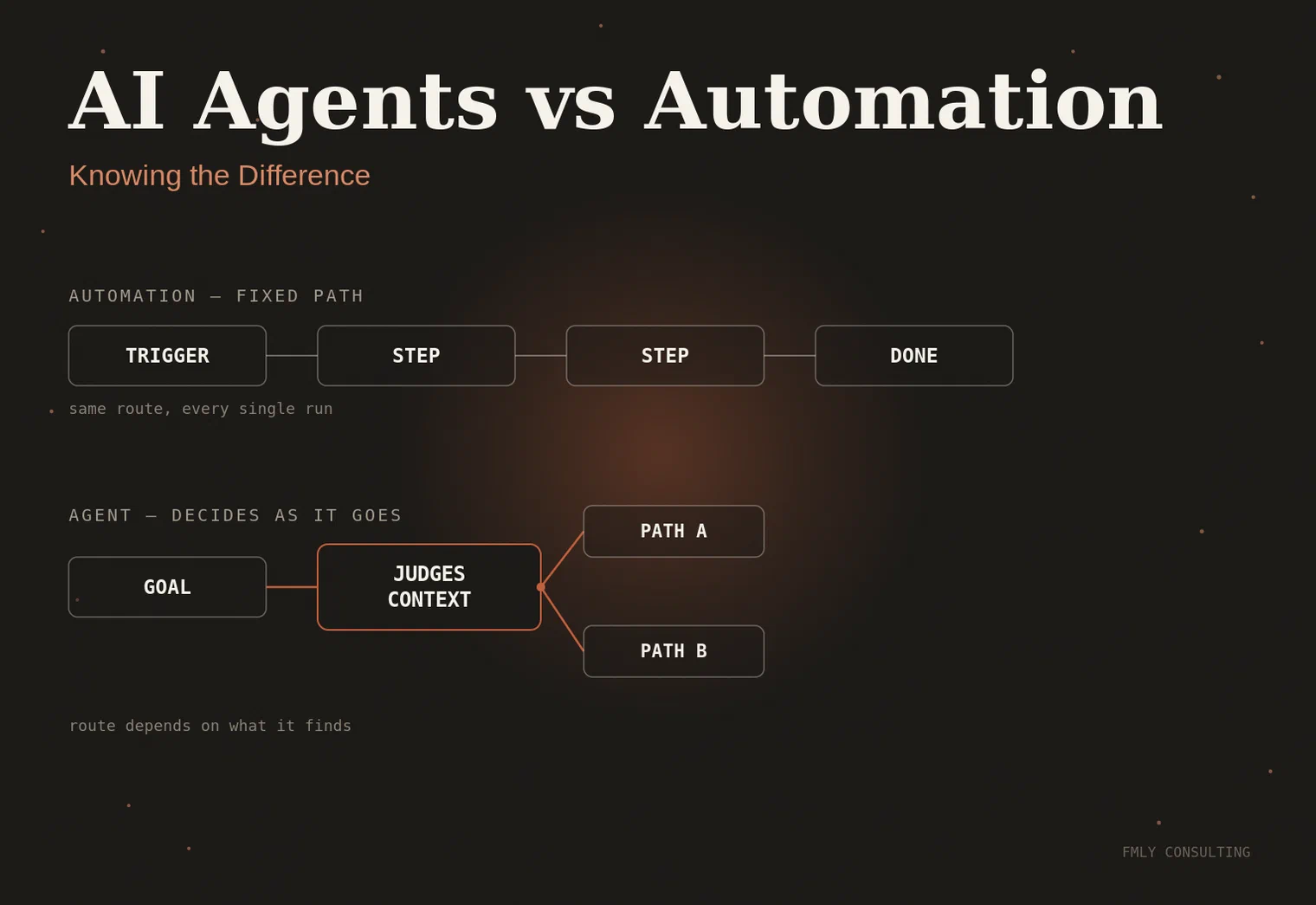
Half the “AI automation” pitches I hear are really just automation with an AI label stapled on, and the other half are agents dressed up to sound like the safe, predictable option. Both framings are selling something, and neither helps you decide what to actually build. The distinction isn’t marketing, it’s structural: automation runs a fixed path, an agent decides the path as it goes. Knowing which one you need before you start building is the difference between a tool that’s boring and reliable and one that’s expensive and unpredictable for no reason.
Automation Is a Path You Already Know
Automation is what you get when a process is well-understood enough to write down as a sequence: if this happens, do that, then that, then stop. A new row in a spreadsheet triggers an email. A signed contract triggers a folder, a calendar invite, and a Slack message. Every run takes the same route because the route was decided in advance, by you, and the system’s only job is to walk it faster and more consistently than a human would.
That predictability is the whole value proposition. When something breaks, you know exactly where, because there’s exactly one place it could have broken. When you audit it, you’re reading a flowchart, not reconstructing a decision. Automation is boring by design, and boring is a feature when the process genuinely doesn’t change shape from one run to the next.
Agents Are a Decision You Delegate
An agent is different in kind, not just degree. Instead of following a fixed sequence, it’s given a goal and some tools, and it figures out the sequence itself, run by run. Ask it to “get this invoice paid” and it might check the vendor record, flag a discrepancy, ask you a clarifying question, or route it differently depending on what it finds. No two runs necessarily look the same, because the path depends on what the agent encounters, not on a diagram you drew ahead of time.
That flexibility is the point, and it’s also the cost. You’re trading a predictable route for a system that can handle situations you didn’t enumerate in advance, at the price of never knowing exactly what any given run will do. Agents earn their keep exactly where automation runs out of road: tasks where the steps genuinely depend on judgment, ambiguous input, or information that only becomes available partway through.
The Test That Actually Tells Them Apart
Forget the marketing copy and ask one question: can you write the steps down in advance, completely, without a “use your judgment here” clause? If yes, you want automation, and adding an AI model into that path buys you nothing but latency and a new failure mode. If the honest answer involves a step where a human currently has to look at something and decide, that step — and only that step — is your candidate for an agent, not the whole process around it.
Most real workflows are actually a mix. The trigger is automation. The routing is automation. The one step in the middle where somebody reads a messy client email and decides what it actually means, that’s agent territory. Building the whole thing as one undifferentiated “AI workflow” is how you end up with a system that’s unpredictable where it should be rock solid, and rigid exactly where you needed it to think.
Default to Automation, Reach for Agents Last
The practical move is to default to automation and reach for an agent only when you hit a step that resists being written down as a fixed sequence. Wire up the deterministic backbone first: the trigger, the data movement, the notifications. Then look at what’s left, the parts where you’re still doing the judgment call by hand, and that’s your short list of places an agent might actually help. Resist the temptation to make everything “smart.” A rules engine that never surprises you is worth more than an agent bolted onto a job that never needed one.
Get that split right and you end up with a system that’s dependable where it has to be and adaptive only where it pays to be — which is what everyone actually wanted from “AI automation” all along.