What Small Businesses Get Wrong About AI Adoption

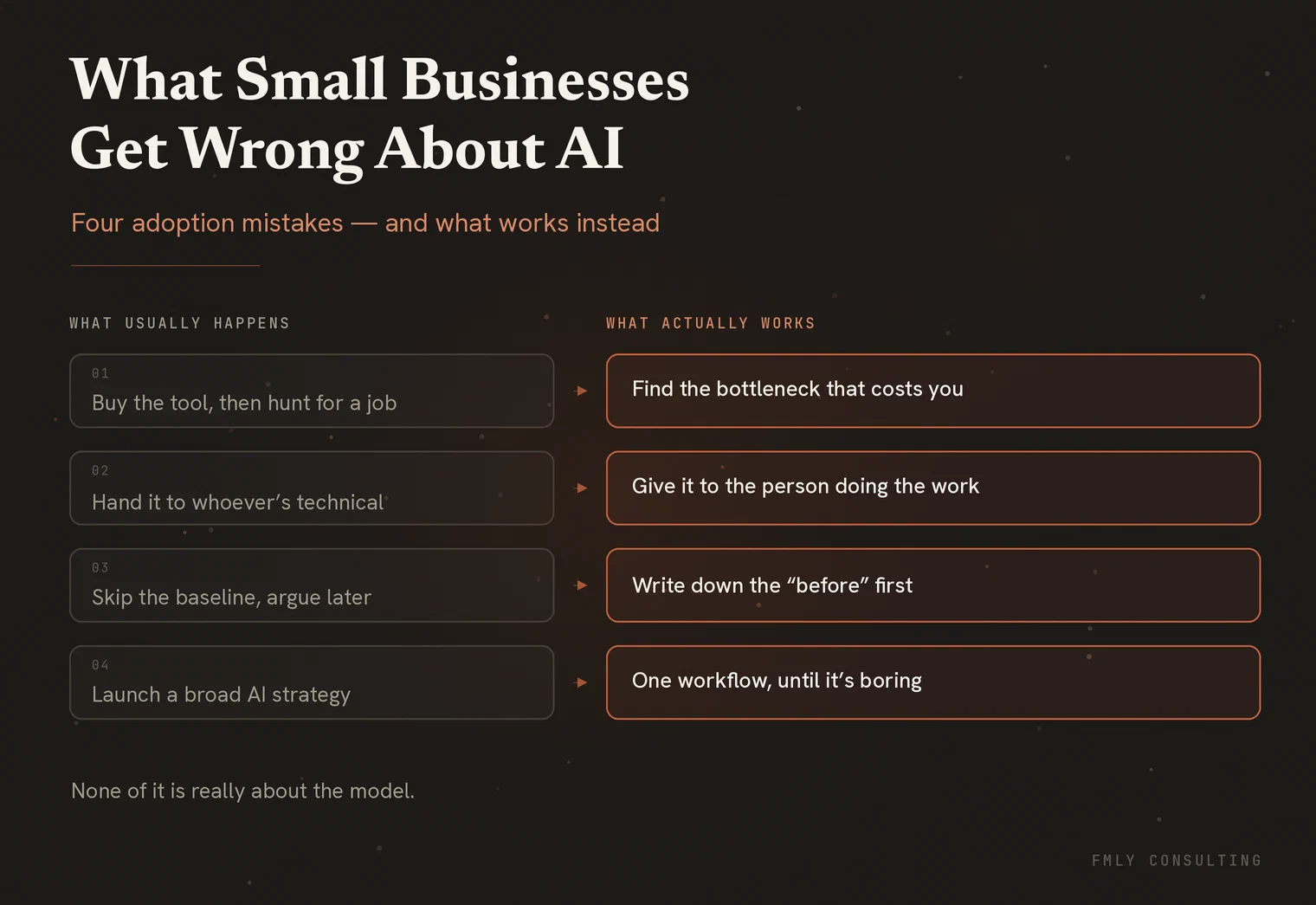
I’ve now watched enough small businesses start AI projects to notice that the ones that stall rarely stall for technical reasons. The model was fine. The integration worked. Somebody demoed it, everyone nodded, and then six weeks later nobody could tell you whether it had saved a single hour. The failure happened earlier and further upstream than anyone wanted to admit — in how the thing was chosen, scoped, and owned. Here’s what I see go wrong most often, and what the shops that get value out of this actually do differently.
Starting With the Tool Instead of the Bottleneck
The most common opening move is backwards: someone sees a compelling demo, buys a seat, and then goes looking for work to feed it. That’s how you end up with a very impressive summarizer pointed at documents nobody was struggling to read. The tool works exactly as advertised and produces nothing of value, because it was never aimed at anything that was costing you money.
The shops that get this right start from the other end. They pick the one task where the same person keeps losing the same two hours a week — retyping intake forms, chasing status updates, rebuilding the same report — and only then ask whether AI is the right lever for it. Sometimes the answer is no, and a scheduled query or a template would fix it for free. That’s a good outcome, not a failed evaluation. Knowing the bottleneck first is what makes the tooling decision easy instead of aspirational.
Treating It as an IT Project With No Owner
The second mistake is organizational. AI gets handed to whoever is most technical, on top of everything else they do, with no explicit mandate and no time carved out. That person builds something reasonable, and then it decays, because nobody’s job description includes maintaining it. Prompts drift out of date. The one person who understood the workflow gets pulled onto a client emergency. Adoption quietly reverts to the old spreadsheet.
What actually sticks is having a named owner who does the work the tool is meant to help with. Not the most technical person — the person whose week gets better if it works. They’re the only one who will notice when output quality slips, and the only one with the standing to tell colleagues “we do it this way now.” Technical help matters for wiring it up, but ownership has to sit with the operator, or the thing has no immune system.
Skipping the Baseline, Then Arguing About Results
Almost nobody measures the before. Then, three months in, there’s a conversation where one person says it’s obviously helping and another says they can’t see it, and neither can produce a number. Without a baseline, that argument is unresolvable, and unresolvable arguments get settled by whoever is more senior rather than by what’s true.
The fix is unglamorous and takes about twenty minutes. Before you deploy anything, write down the current state of the task you’re targeting: how long it takes, how often it happens, how often it has to be redone. One line in a doc is enough. Then you’ll know within a month whether you have a win worth expanding or a tool worth cutting, and you’ll be able to show a client or a partner the same evidence you used to convince yourself.
Going Broad Before Anything Works
The last pattern is scope. Rather than proving one workflow end to end, the plan becomes an “AI strategy” touching sales, support, and delivery simultaneously. Every piece is half-built, none of it is trusted, and the effort collapses under its own surface area. Small teams don’t have the slack to run three inconclusive experiments at once.
Pick one workflow. Instrument it. Run it until it’s genuinely boring and people stop talking about it as an AI thing. That first boring win is what buys you the credibility and the pattern to do the second one, and the second one takes a fraction of the effort because you’ve already solved the ownership and measurement questions once.
None of this is really about AI. It’s the same discipline that separates software projects that pay for themselves from the ones that turn into shelfware: aim at a real cost, give it an owner who cares, measure it, and keep the scope small enough to finish. If you’re weighing where AI actually fits in your operation — or trying to figure out why last quarter’s pilot never went anywhere — that’s the conversation FMLY Consulting is built for. We’d rather help you find the one workflow worth automating than sell you a strategy deck.